As a follow-up to last week’s post on One-Man Bands (i.e., players who led their team in points, rebounds, assists, steals, and blocks), I decided to look at players who accounted for the largest percentage of their team’s total in each of the five major statistical categories.
Points
Wilt Chamberlain scored an NBA-record 4,029 points in 1961-62, accounting for 40.15% of the Philadelphia Warriors’ team total. He recorded 45 50-point games that season, 14 more such games than the career total of any other player in NBA history (Michael Jordan, 31).
Chamberlain’s season high was 100 points versus the New York Knicks on March 2, 1962, while his season low was 26 points against the Boston Celtics on Feb. 24, 1962. The 1961-62 season opener marked the start of a 106-game streak in which Chamberlain scored at least 25 points, the longest such streak in NBA history by a whopping 59 games.
The 1961-62 Warriors finished second in the Eastern Division with a record of 49-33. In the playoffs, they lost in the Eastern Division Finals to the Boston Celtics in a tense 7-game series.
This was the third of seven consecutive seasons in which Chamberlain led the NBA in points, tied with Michael Jordan for the longest such streak in NBA history. It was also the third of four straight seasons in which Chamberlain was the league leader in both points and rebounds. No other player in NBA history has even done that in back-to-back seasons.
Rebounds
Dennis Rodman was a rebounding machine, snagging a career-high 1,530 boards in 1991-92. That number represented 42.14% of the Detroit Pistons’ team total, the highest such figure in NBA history. Rodman’s 1,530 rebounds that season remains the highest individual figure since the ABA-NBA merger in 1976.
Rodman recorded double-digit rebounds in 77 of his 82 games that season. He grabbed a career-high 34 boards on March 4, 1992 versus the Indiana Pacers, a mark that still stands as the franchise’s single-game record.
The 1991-92 Pistons posted a regular season record of 48-34, good for third in the Central Division. They fell to the New York Knicks in five games in the First Round of the Eastern Conference Playoffs.
This was the first of seven consecutive seasons in which Rodman led the league in rebounds per game, the longest such streak in NBA history. In the last season of that streak (1997-98), Rodman became the oldest player to lead the NBA in rebounding, with an age of 36 years and 341 days on the final day of the regular season.
Assists
Chris Paul led the NBA in assists in 2008-09 with 861, a figure that represents 53.51% of the New Orleans Hornets’ team total that season. Paul’s team-leading total was 688 assists higher than the next-closest Hornet (David West, 173), the ninth-largest such difference in NBA history.
Paul recorded double-digit assists in 51 of his 78 games that season, the second-highest such total in franchise history (he had 59 10-assist games the previous season). Paul also led the team in scoring (22.8 PPG) and ranked third in rebounding (5.5 RPG), both career-high figures.
The 2008-09 Hornets had a regular season mark of 49-33, good for just fourth place in a competitive Southwest Division that featured three 50-win teams. They bowed out of the Western Conference Playoffs in the First Round, falling to the Denver Nuggets 4-1.
Paul also led the NBA in steals (216) and steals per game (2.8) that season. He’s been the league leader in steals five times and steals per game six times, both the most such seasons since the NBA began tracking steals in 1973-74.
Steals
Alvin Robertson set the NBA single-season record* with 301 steals in 1985-86. The San Antonio Spurs recorded 800 steals as a team, so Robertson accounted for 37.63% of the team’s total.
* Keep in mind the NBA did not begin tracking steals and blocks until 1973-74.
Robertson recorded at least one steal in 81 of his 82 games that season, with multiple steals in 71 of those games. Robertson’s season high was 10 steals on Feb. 18, 1986 versus the Phoenix Suns, when he became the second NBA player to officially record a quadruple-double (he also had 20 points, 11 rebounds, and 10 assists).
The 1985-86 Spurs went just 35-47 during the regular season, finishing sixth out of six teams in the Midwest Division. The Spurs still qualified for the Western Conference Playoffs, where they were swept in the First Round by the Los Angeles Lakers.
This was the first of six seasons in which Robertson recorded at least 200 steals, tied with Michael Jordan for the most such seasons in NBA history. Robertson is the only player to record multiple 250-steal seasons (he had 260 steals in 1986-87, which ranks sixth on the league’s single-season list).
Blocks
Hakeem Olajuwon blocked a career-high 376 shots in 1989-90, more than two-thirds of the Houston Rockets’ team figure (68.24%, to be exact). It’s still the NBA’s fourth-highest single-season total:
456 — Mark Eaton (1984-85)
397 — Manute Bol (1985-86)
393 — Elmore Smith (1973-74)
376 — Hakeem Olajuwon (1989-90)
Olajuwon recorded at least one block in 79 of his 82 games. He blocked at least 10 shots four times, with a high of 12 blocks versus the Utah Jazz on Nov. 11, 1989. On March 29, 1990, Olajuwon became the third NBA player to officially record a quadruple-double, compiling 18 points, 16 rebounds, 11 blocks, and 10 assists versus the Milwaukee Bucks.
The Rockets finished fifth in the Midwest Division with a record of 41-41 that season. They were eliminated in the First Round of the Western Conference Playoffs by the Los Angeles Lakers, 3-1.
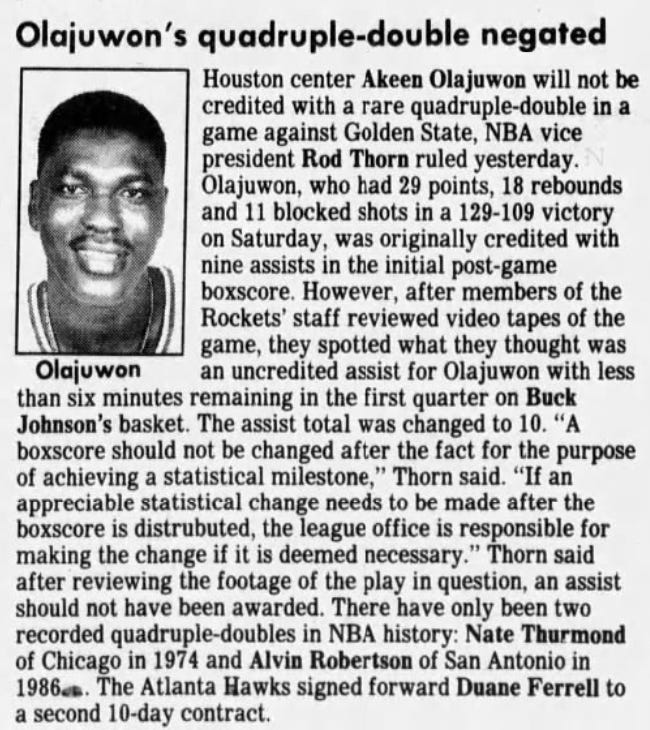
An interesting side note from this season: on March 3, 1990, Olajuwon recorded 29 points, 18 rebounds, 11 blocks, and nine assists versus the Golden State Warriors. After the game, the Rockets reviewed the game tape and “found” another assist for Olajuwon, giving him a quadruple-double. Two days later, the NBA stepped in and said the Rockets could not change a box score after the fact (see below).