


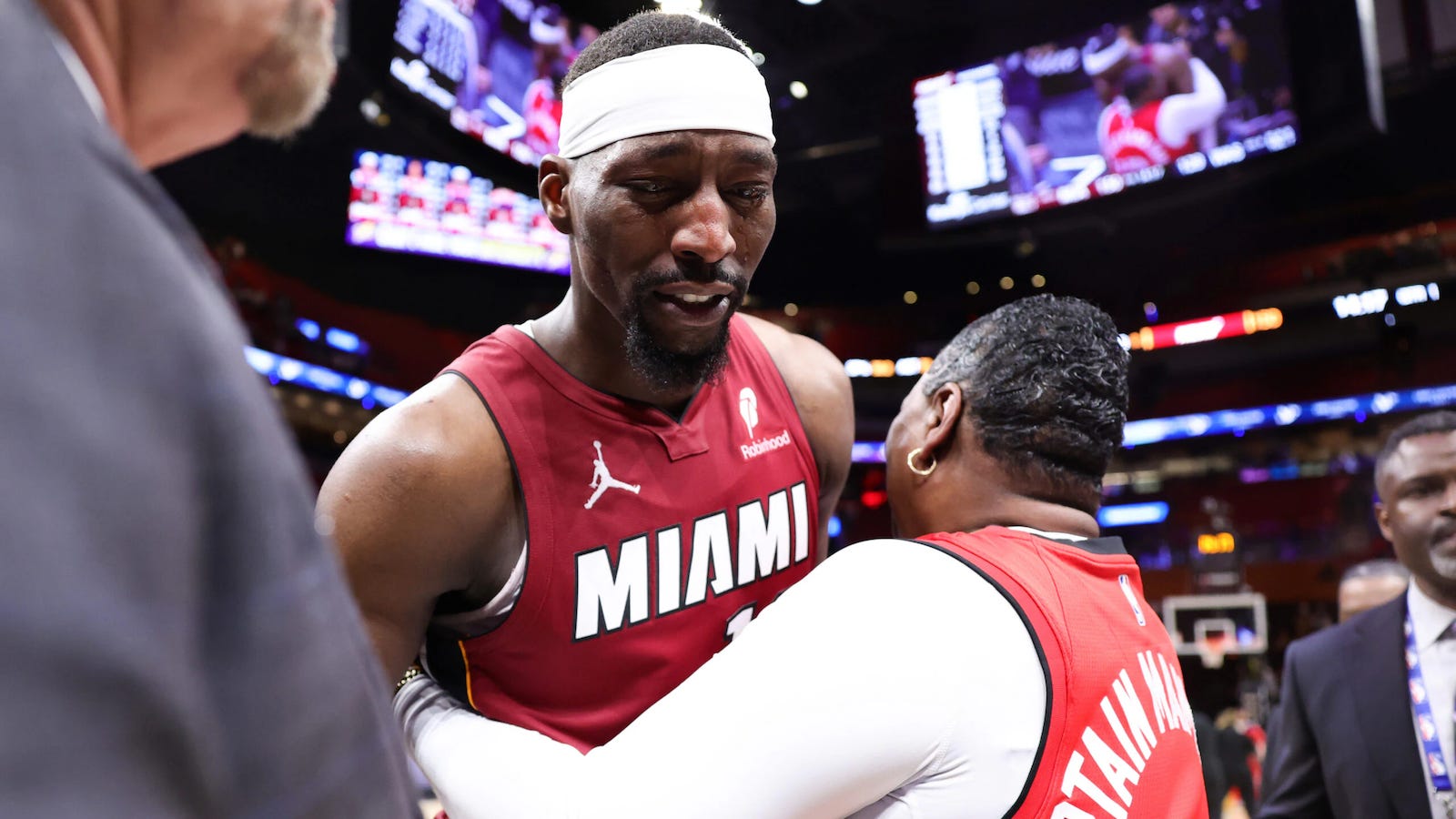
One week ago today, Miami Heat center Bam Adebayo scored an astounding 83 points versus the Washington Wizards, the second-highest total in NBA history. That improbable performance motivated me to update up a post I originally wrote back in November 2022. The question of interest was “How can we rate the biggest fluke scoring performances in NBA history?”
One way to tackle this problem is to subtract the player’s career scoring average from his point total for a given game:
PTS – PPG
However, this method gives the same score to:
Player A who scores 30 points and has a career scoring average of 5.0 PPG; and
Player B who scores 50 points and has a career scoring average of 25.0 PPG
Here’s the math:
Player A = 30 – 5.0 = 25.0
Player B = 50 – 25.0 = 25.0
If we’re looking for fluke performances, Player A’s effort is definitely a better fit (definitionally speaking) than Player B’s.
Another approach is to find the percentage difference between the player’s point total for a game and his career scoring average:
(PTS – PPG) / PPG
Again, though, this method has some issues when it comes to identifying fluke performances. For example, consider:
Player A who scores 10 points and has a career scoring average of 2.5 PPG; and
Player B who scores 50 points and has a career scoring average of 12.5 PPG
Again, here’s the math:
Player A = (10 – 2.5) / 2.5 = 3.0
Player B = (50 – 12.5) / 12.5 = 3.0
These players end up with the same score, even though I think everybody would call Player B’s performance the much bigger fluke.
Since neither of the approaches above work well alone, why not combine them? In other words:
(PTS – PPG)^2 / PPG
Note that this will capture fluke performances in either direction, as the numerator will always be positive, but that’s fine. Anyway, let’s go back to the first example:
Player A = (30 – 5.0)^2 / 5.0 = 125
Player B = (50 – 25.0)^2 / 25.0 = 25
Now, Player A’s performance is deemed a much bigger fluke, a conclusion I think most people would agree with.
Here’s the second example:
Player A = (10 – 2.5)^2 / 2.5 = 22.5
Player B = (50 – 12.5)^2 / 10.0 = 112.5
This time, Player B’s effort is classified as the more surprising outcome. Again, this would seem to match the general consensus.
Now let’s dig into some results. We’ll start with 70-point games, since Adebayo is the one who motivated me to update this work. Here are the fluke scores for the 16 cases in NBA history in which a player scored at least 70 points in a game:
276.8 — Bam Adebayo (83 PTS, 16.1 PPG)
162.7 — Wilt Chamberlain (100 PTS, 30.1 PPG)
125.5 — Kobe Bryant (81 PTS, 25.0 PPG)
118.4 — David Robinson (71 PTS, 21.1 PPG)
116.9 — David Thompson (73 PTS, 22.1 PPG)
84.3 — Devin Booker (70 PTS, 24.5 PPG)
84.2 — Donovan Mitchell (71 PTS, 25.1 PPG)
83.9 — Damian Lillard (71 PTS, 25.1 PPG)
76.4 — Chamberlain (78 PTS, 30.1 PPG)
69.6 — Elgin Baylor (71 PTS, 27.4 PPG)
66.3 — Luka Doncic (73 PTS, 29.1 PPG)
65.0 — Joel Embiid (70 PTS, 27.6 PPG)
61.3 — Chamberlain (73 PTS, 30.1 PPG)
61.3 — Chamberlain (73 PTS, 30.1 PPG)
58.5 — Chamberlain (72 PTS, 30.1 PPG)
53.0 — Chamberlain (70 PTS, 30.1 PPG)
As you can see, Adebayo laps the field when it comes to this measure, as he’s the only player in the 70-point club with a career scoring average less than 20 PPG. Given that Adebayo is active and has yet to begin his decline phase, it’s likely his career scoring average will end up being less than his current mark, meaning his fluke score will increase.
Let’s drop the cutoff down to 50 points. Here are the five biggest fluke 50-point games in NBA history (at least by this measure):
363.7 — Malachi Flynn (50 PTS, 5.5 PPG)
276.8 — Bam Adebayo (83 PTS, 16.1 PPG)
211.9 — Tony Delk (53 PTS, 9.1 PPG)
206.8 — Corey Brewer (51 PTS, 8.7 PPG)
203.4 — Walt Wesley (50 PTS, 8.5 PPG)
Some observations:
Flynn’s 50-piece came with the Detroit Pistons on April 3, 2024 versus the Atlanta Hawks. In fact, it was his first (and still only) career 30-point game. Take away this performance and his career high is 27 points.
Tony Delk appeared in 545 career games and was held scoreless in more than 10% of them (55, to be exact). Like Flynn, the second-highest total of Delk’s career is 27 points.
Walt Wesley was a 6-foot-11-inch center who played for eight different franchises over his 10 seasons in the NBA. His 50-point game came during the 1970-71 campaign with the expansion Cleveland Cavaliers, when Wesley averaged a career-high 17.7 PPG. That season was by far his best, although it should be noted that the Cavaliers were awful, finishing a league-worst 15-67.
Next, we’ll remove the 50-point requirement and look at all games:
363.7 — Malachi Flynn (50 PTS, 5.5 PPG)
288.3 — Kenneth Lofton Jr. (42 PTS, 4.8 PPG)
276.8 — Bam Adebayo (83 PTS, 16.1 PPG)
269.4 — Hank Finkel (42 PTS, 5.1 PPG)
268.0 — Thanasis Antetokounmpo (27 PTS, 2.3 PPG)
A note about Finkel: three of the five highest-scoring games in his 551-game career came on three consecutive days (March 6–8, 1968). Playing for the expansion San Diego Rockets, Finkel averaged 21.7 PPG in March 1968, the highest monthly figure of his career by almost 8.0 PPG.
As you can see from cases like Wesley’s and Finkel’s, sometimes a player just has a fluke season. In other words, within the context of their season, the performance may not have been that unusual.
So instead of using the player’s career scoring average, let’s use his season scoring average instead. With that change, here's the new list for 50-point games:
359.5 — Malachi Flynn, 2023-24 (50 PTS, 5.5 PPG)
233.6 — Jamal Crawford, 2018-19 (51 PTS, 7.9 PPG)
197.9 — Bam Adebayo, 2025-26 (83 PTS, 20.0 PPG)
148.5 — Terrence Ross, 2013-14 (51 PTS, 10.9 PPG)
135.4 — Tony Delk, 2000-01 (53 PTS, 12.3 PPG)
And here’s the new list for all games:
359.5 — Malachi Flynn, 2023-24 (50 PTS, 5.5 PPG)
294.8 — Anfernee Simons, 2018-19 (37 PTS, 3.8 PPG)
282.1 — Walter McCarty, 2000-01 (27 PTS, 2.2 PPG)
273.8 — Kenneth Lofton Jr., 2022-23 (42 PTS, 5.0 PPG)
270.2 — Pat Connaughton, 2024-25 (43 PTS, 5.3 PPG)
Some items of note:
Jamal Crawford’s 51-point effort came with the Phoenix Suns on April 9, 2019 versus the Dallas Mavericks. At 39 years and 20 days old, Crawford became the oldest player in NBA history to record a 50-point game, a distinction he still holds. He also became the first player in NBA history to record a 50-point game for four different franchises.
Anfernee Simons’ 37-point outburst came just one day after Crawford’s performance, in the Portland Trail Blazers’ final game of the 2018-19 season. He was one of three Blazers to go the full 48 minutes in that game. Going into that night, Simons had never played more than 13 minutes in a game.
Walter McCarty was held scoreless in 35 of his 60 games during the 2000-01 season. He only scored in double figures twice, with his second-highest scoring game that season being an 11-point effort.
When I originally wrote this piece, I chose Delk’s 53-point game as the biggest fluke scoring performance in NBA history, with Corey Brewer’s 51-point effort a close second. My reasoning was Delk and Brewer were the only 50-point scorers to have a career scoring average and a season scoring average less than 10 PPG.
With additional seasons of data, I’m going to update that answer to Malachi Flynn, who easily comes out on top no matter how we look at it:
50-point cutoff vs. no cutoff
career scoring average vs. season scoring average
By way the way, Flynn went 0-12 from the floor the game after his outlier performance. He’s one of only two players in NBA history to be held without a field goal in the game immediately following a 50-point game. The other is Anthony Davis, who missed the final three quarters of his game on Dec. 6, 2022 due to an illness after a 55-point effort his previous outing. Davis did not attempt a field goal in that game.
An important point that you mentioned only briefly is that many of these outliers occur in regular season finales, when teams not only have nothing to play for but also occasionally field G-league rosters. I think they deserve a hefty asterisk.
Crawford, Simons, Lofton, Connaughton, Thanasis and Alec Peters who somehow didn't make the cut here (2.4 PPG with a career-high of 8 before a 36 point game) were all season-enders, whereas McCarty, Brewer and Flynn were very close to it.
In contrast, Ross and Delk's 50-pieces are notable being mid-season games with both teams playing seriously (which is only half true regarding Bam's 83...).
I'll add that Thompson's 73 and Robinson's 71 were also season-enders, both in attempt to capture the scoring crown, the latter successful (over a young Shaq), the former falling short due to Gervin scoring a career-high 63 in 33 minutes, chucking 49 shots! (23/49)
Also notable was Kobe's season and career-ender of 60 in 22/50 shooting.
Both games are the top two in FGA since the merger (Jordan also shot 49 once but in an OT game).
This is an elite breakdown!