


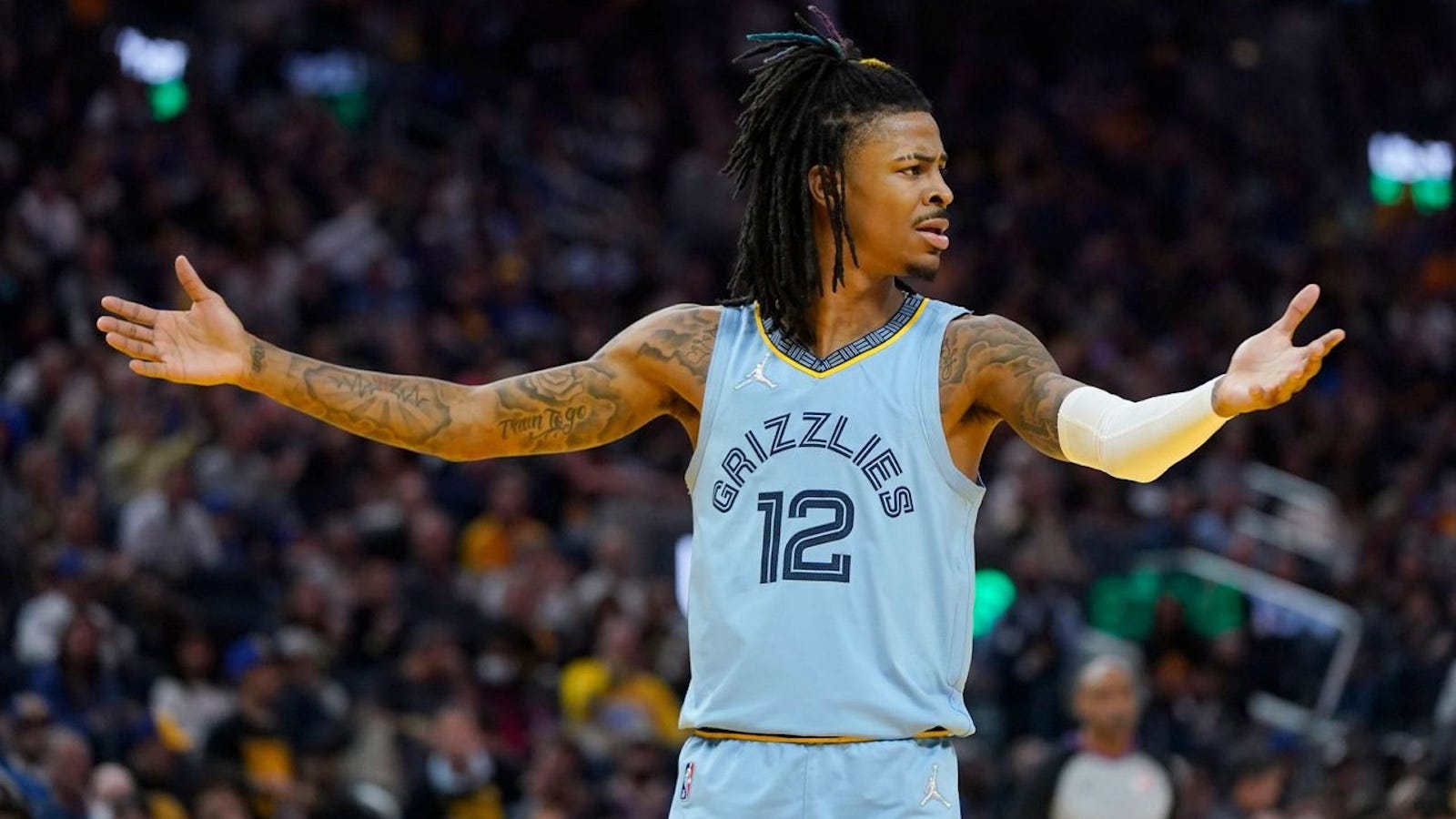
Last season, the Memphis Grizzlies became just the eighth team in NBA history to follow-up a 50-win season with a 50-loss season, going from 51-31 in 2022-23 (second in the Western Conference) to 27-55 in 2023-24 (13th). So many things went wrong for the Grizzlies, including:
All-NBA guard Ja Morant was suspended the first 25 games of the season, returned for nine of the next 10 games, then missed the remainder of the campaign with a shoulder injury.
Desmond Bane, who averaged 21.5 PPG in 2022-23, missed almost half the season (40 games) with an ankle injury.
Marcus Smart, an offseason acquisition and former Defensive Player of the Year, missed 62 games due to injuries.
Starting center Steven Adams missed the entire season with a knee injury.
Forward Brandon Clarke, a solid bench player, missed the first 72 games due to a torn Achilles suffered the previous season.
All told, the Grizzlies had 33 players appear in at least one game, an NBA record. They used 51 different starting lineups, the most by a team since the league began tracking starters in 1970-71.
I thought it might be interesting to take a closer look at the seven other teams that went from the penthouse to the outhouse. I’ll take a look at what happened to each team to cause the fall, and see if they were able to bounce back the next season.
1960-1962 St. Louis Hawks
W-L Records
51-28 (1960-61)
29-51 (1961-62)
What Happened?
The 1960-61 Hawks lost in the NBA Finals to the Boston Celtics, but the next season was a disaster, as the club lost 51 games and went through three head coaches in the process.
Lenny Wilkens had a solid rookie season for the Hawks in 1960-61, but in 1961-62 he played in just 20 games while fulfilling his military commitment to the U.S. Army. Meanwhile, Hall of Fame center Clyde Lovellette was limited to 40 games thanks to a foot injury suffered in early January.
And as luck would have it for the Hawks, Wilkens’ military service and Lovellette’s injury were timed such that the pair appeared in just one game together all season (on February 3, a game in which Lovellette played just one minute). In fact, that was the only appearance Lovellette made from January 5 through the end of the season.
The Next Season
The Hawks rebounded nicely in 1962-63, finishing 48-32 in the regular season before losing to Lakers in seven games in the Western Division finals.
1979-1981 Atlanta Hawks
W-L Records
50-32 (1979-80)
31-51 (1980-81)
What Happened?
After winning the Central Division title and finishing with the third-best record in the Eastern Conference in 1979-80, the Hawks fell all the way to eighth place in the conference in 1980-81. Head coach Hubie Brown was fired with just three games remaining in the season.
The Hawks’ starting frontcourt was bitten by the injury bug:
Small forward John Drew, who made the only All-Star Game of his career in 1979-80, missed 15 games, including the last 12 of the season.
Power forward Dan Roundfield, an All-Star selection both seasons, missed 19 games.
Center Tree Rollins, who had been fantastic in 1979-80 (9.4 RPG and 3.0 BPG in 25.9 MPG), missed 42 games due to a knee injury.
The Hawks were especially bad without Roundfield in the lineup, winning just two of the 19 games he did not suit up.
The Next Season
Atlanta returned to the postseason in 1981-82 with Kevin Loughery at the helm, but at 42-40 they were the final team to qualify for the postseason. In the playoffs, they were swept in the first round by the Philadelphia 76ers.
1993-1995 Golden State Warriors
W-L Records
50-32 (1993-94)
26-56 (1994-95)
What Happened?
Despite being the second-youngest team in the NBA, the 1993-94 Warriors won 50 games* and qualified for the playoffs. But things fell apart in 1994-95, as head coach Don Nelson was fired halfway through a 56-loss season.
* They managed to do this without the services of All-Star point guard Tim Hardaway, who missed the season due to a knee injury.
Chris Webber had an impressive debut season in 1993-94, winning the NBA's Rookie of the Year Award while averaging 17.5 PPG, 9.1 RPG, and 3.6 APG. However, Webber and Nelson did not see eye-to-eye on the best way to use Webber.
Nelson had a propensity to employ smaller lineups, which meant that the 6-foot-10-inch Webber often played extended minutes at the center position. Webber — a great passer with good ball-handling skills for someone his size — did not see himself as a classic post player and grew irritated with Nelson's use of him.
Unfortunately for the Warriors, Webber’s contract had a one-year escape clause, which he threatened to exercise after concluding that he could no longer play for Nelson.
Without Webber, who was holding out for a trade, the Warriors actually started the 1994-95 season with five wins in their first six games. On November 19, an end to the impasse between the Warriors and Webber was reached when Webber was dealt to the Washington Bullets for Tom Gugliotta and three first round draft picks.
Golden State’s record eventually reached 7-1, but then the bottom fell out: 22 losses in the next 25 games, a stretch that included losing streaks of 10 games and eight games. Nelson was fired after 45 games (14-31), with Bob Lanier serving as interim coach for the remainder of the season.
The Next Season
With Rick Adelman at the helm, Golden State jumped to 36 wins in 1995-96 but finished in ninth place in the conference, three games out of the final playoff spot. However, the Warriors lost 50 games yet again in 1996-97 (52, to be exact) and Adelman was fired.
1995-97 San Antonio Spurs
W-L Records
59-23 (1995-96)
20-62 (1996-97)
What Happened?
The Spurs finished with the second-best record in the Western Conference in 1995-96, but Hall of Fame center David Robinson played just six games in 1996-97 as San Antonio staggered through a 62-loss season. Head coach Bob Hill was fired after just 18 games and replaced by Gregg Popovich.
Robinson had been a force in 1995-96 — he finished runner-up in the MVP voting and was named to the All-NBA and All-Defensive First Teams — and his loss was a death blow to the Spurs. “The Admiral” hurt his back in the preseason and did not make his first appearance until December 10. Just six games later, on December 26, Robinson broke his foot in a loss to the Miami Heat and missed the remainder of the season.
As if Robinson's injury wasn't bad enough, forward Sean Elliott missed 43 games due to tendinitis in his right leg. Elliott had been an All-Star selection in 1995-96, averaging a career high 20.0 PPG with a true shooting percentage of 58.5%, the second-best mark of his career.
The Next Season
The Spurs won the NBA Draft lottery and selected Tim Duncan. The combination of Duncan and a healthy Robinson proved to be one of the best post combos of all time, and the Spurs improved by 36 wins, at the time an NBA record. One season later, they were NBA champions for the first time.
2009-11 Cleveland Cavaliers
W-L Records
61-21 (2009-10)
19-63 (2010-11)
What Happened?
I should note that the 2010-11 Cavaliers are the only team in NBA history to follow-up a 60-win season with a 60-loss season.
The Next Season
The Cavaliers were still one of the worst teams in the NBA, but they did win more games in the 66-game, lockout-shortened season (21) than they did in 2010-11.
2018-2020 Golden State Warriors
W-L Records
57-25 (2018-19)
15-50 (2019-20)
What Happened?
You name it, it happened: significant injuries, major personnel moves, even a pandemic.
The Warriors fell to the Toronto Raptors in the 2019 NBA Finals, losing All-Star guard Klay Thompson in Game 6 to a knee injury that would sideline him for the entire 2019-20 season.
In the offseason, All-NBA forward Keven Durant was sent to the Brooklyn Nets in a sign-and-trade deal that brought back D’Angelo Russell (among others). Russell lasted less than one season in Golden State, as he was shipped to the Minnesota Timberwolves for Andrew Wiggins on Feb. 6, 2020.
And in just the fourth game of the season, two-time MVP Award winner Stephen Curry broke his hand, an injury which required surgery and kept him out of 60 of the season’s remaining 61 games.
Golden State’s season came to premature end on March 10, 2020 with a 131-107 loss to the LA Clippers. The next day, the NBA suspended its season due to the COVID-19 pandemic. When the campaign resumed in Orlando on July 30, the Warriors were one of eight teams not invited to the Walt Disney World “bubble.”
The Next Season
The Warriors improved to 39-33 in 2020-21, but were knocked out in the Play-In Tournament. They still played without the services of Thompson, who missed yet another full season, this time with a torn Achilles. However, in 2021-22 Golden State returned to the NBA Finals for the sixth time in eight seasons, winning their fourth championship in that span.