


The Keltner List is a series of subjective questions formulated by famed sabermetrician Bill James used to help assess whether or not a player should be elected to the National Baseball Hall of Fame.
Although the system was designed to evaluate baseball players, with a few minor tweaks it can also be used to assess the Hall-worthiness of basketball players. In this post, I will examine Larry Nance’s case for the Basketball Hall of Fame.
Was he ever regarded as the best player in basketball? Did anybody, while he was active, ever suggest that he was the best player in basketball?
Nope and nope.
Was he the best player on his team?
Nance was, in my opinion, clearly the best player on the Phoenix Suns from 1982-83 until he was traded to the Cleveland Cavaliers on February 25, 1988:
Larry Nance — 407 GP, 35.7 MPG, 20.2 PER
Walter Davis — 398 GP, 31.3 MPG, 18.4 PER
Alvan Adams — 460 GP, 24.7 MPG, 16.2 PER
From 1988-89 through 1992-93, it’s not so clear. Nance was one of the best players on the Cavaliers, but those were some very good teams, and it’s hard to decide who was the best player among Nance, Mark Price, and Brad Daugherty:
Larry Nance — 373 GP, 35.3 MPG, 20.2 PER
Mark Price — 311 GP, 33.8 MPG, 21.6 PER
Brad Daugherty — 339 GP, 37.0 MPG, 20.2 PER
I think Price was their best player when he played, but he missed 99 games in those five seasons, including 66 games during the 1990-91 season*. Regardless, Nance was in the running for best player on his team for 11 straight seasons, an impressive run.
* That season was a disaster for the Cavs, as they limped to a 24-42 finish after Price’s knee injury. Perhaps that’s a good argument in favor of Price.
Was he the best player in basketball at his position?
No, he was not. The best power forwards in basketball during Nance’s era were Charles Barkley, Karl Malone, and Kevin McHale. For what it’s worth, I would rank Nance fourth in that time period.
Did he have an impact on a number of NBA Finals or conference finals?
Nance never played in the NBA Finals, but he did play in two conference finals:
In the 1984 Western Conference Finals, Nance’s Suns lost to the heavily-favored Los Angeles Lakers in six games. Nance played very well, though, averaging 21.5 PPG and 10.5 RPG while shooting 60.2% from the floor.
In the 1992 Eastern Conference Finals, the 67-win Chicago Bulls beat Nance’s Cavaliers in six games. Once again Nance played well, posting per-game averages of 17.8 points, 9.0 rebounds, and 3.3 blocks.
Was he good enough that he could play regularly after passing his prime?
Yes, he was. Nance was 34 years old when he played in his third and final All-Star Game in 1993. He retired following an injury-riddled 1993-94 season.
Is he the very best (eligible) basketball player in history who is not in the Hall of Fame?
No, as I’ve stated before I believe Chauncey Billups holds that somewhat-dubious honor.
Are most players who have comparable statistics in the Hall of Fame?
Since the NBA began tracking blocks in 1973-74, Nance is one of only 10 players to reach career totals of 15,000 points and 2,000 blocks:
Kareem Abdul-Jabbar
Tim Duncan
Patrick Ewing
Kevin Garnett
Dwight Howard
Larry Nance
Hakeem Olajuwon
Shaquille O’Neal
Robert Parish
David Robinson
Eight of these players are Hall of Famers. The exceptions are Nance (of course) and Dwight Howard, who will almost surely be elected to the Hall of Fame when he’s eligible. That said, Nance really doesn’t belong in a group with the rest of these players, as he just skirts by the minimum in each category (15,687 points and 2,027 blocks, each the smallest total in the group).
If you calculate Nance’s career value as described in this post, you’ll find he ranks 82nd among all players and 65th among Hall-of-Fame eligible players. Looking at the five eligible players directly above and below Nance, it’s something of a mixed bag:
Jason Terry
Horace Grant
Rasheed Wallace
Amar’e Stoudemire
Zach Randolph
Jack Sikma
Dikembe Mutombo
Jeff Hornacek
Terry Cummings
James Worthy
Three of these players have been elected to the Hall of Fame: Jack Sikma, Dikembe Mutombo, and James Worthy.
Do the player’s numbers meet Hall of Fame standards?
Nance’s Hall of Fame Probability is 4.75%, which is quite low. If you look at the five eligible players directly above and below him, you’ll find only two who have been elected to the Hall of Fame:
Tom Chambers (5.20%)
Gus Johnson (5.01%)
Latrell Sprewell (5.00%)
Johnny Green (4.90%)
Rolando Blackman (4.83%)
Doug Collins (4.66%)
Maurice Lucas (4.62%)
Vin Baker (4.61%)
Connie Hawkins (4.51%)
Bill Bridges (4.42%)
The Hall of Famers are Gus Johnson and Connie Hawkins, and Hawkins was a two-time All-ABA First Team selection and one-time ABA MVP (not factored into the above).
Nance’s Hall of Fame standards score is 36, which puts him in the “feasible candidate” range. Nance is tied for 23rd place among all eligible non-Hall of Famers by this measure.
Note that both of the measures used above are based on past voting tendencies. In other words, they don’t necessarily reflect who should be elected to the Hall of Fame, but rather who will be.
Is there any evidence to suggest that the player was significantly better or worse than is suggested by his statistics?
There is some evidence, yes. Traditional statistics are inadequate, at best, for evaluating defense, and Nance was by all accounts a very good defensive player, earning three All-Defensive selections (one First Team, two Second Team).
Is he the best player at his position who is eligible for the Hall of Fame?
Yes, I think that Nance is the best eligible power forward who has not yet been elected to the Hall of Fame.
How many MVP-type seasons did he have? Did he ever win an MVP award? If not, how many times was he close?
Nance never won the MVP Award, nor did he ever come close. In fact, the only time he received votes was following the 1988-89 season, when he finished tied for 13th place with three points in the balloting.
How many All-Star-type seasons did he have? How many All-Star games did he play in? Did most of the players who played in this many All-Star games go into the Hall of Fame?
Nance was selected to play in just three All-Star Games, an unimpressive total for a Hall-of-Fame candidate. There are 31 eligible players with exactly three All-Star selections; four of them are in the Hall of Fame, 27 are not.
I sometimes define an “All-Star-type” season as one in which a player records a PER of 20.0 or higher while playing at least 50% of all possible minutes (about 2,000 minutes in an 82-game season). Nance recorded six such seasons:
1984-85 — 2,202 MIN, 20.6 PER
1985-86 — 2,484 MIN, 20.5 PER
1986-87 — 2,569 MIN, 22.2 PER
1987-88 — 2,383 MIN, 20.3 PER
1990-91 — 2,927 MIN, 20.6 PER
1991-92 — 2,880 MIN, 21.4 PER
Eighteen other eligible players have recorded exactly six such seasons; 13 of them (72.2%) have been elected to the Hall of Fame.
If this man were the best player on his team, would it be likely that the team could win an NBA title?
Likely? No, but I believe that a team with a player like Nance as its best player plus a strong supporting cast would have an outside shot to win a title. Nance couldn’t carry a team to a title, but to be fair those players are few and far between.
What impact did the player have on basketball history? Was he responsible for any rule changes? Did he introduce any new equipment? Did he change the game in any way? Was his college and/or international career especially noteworthy?
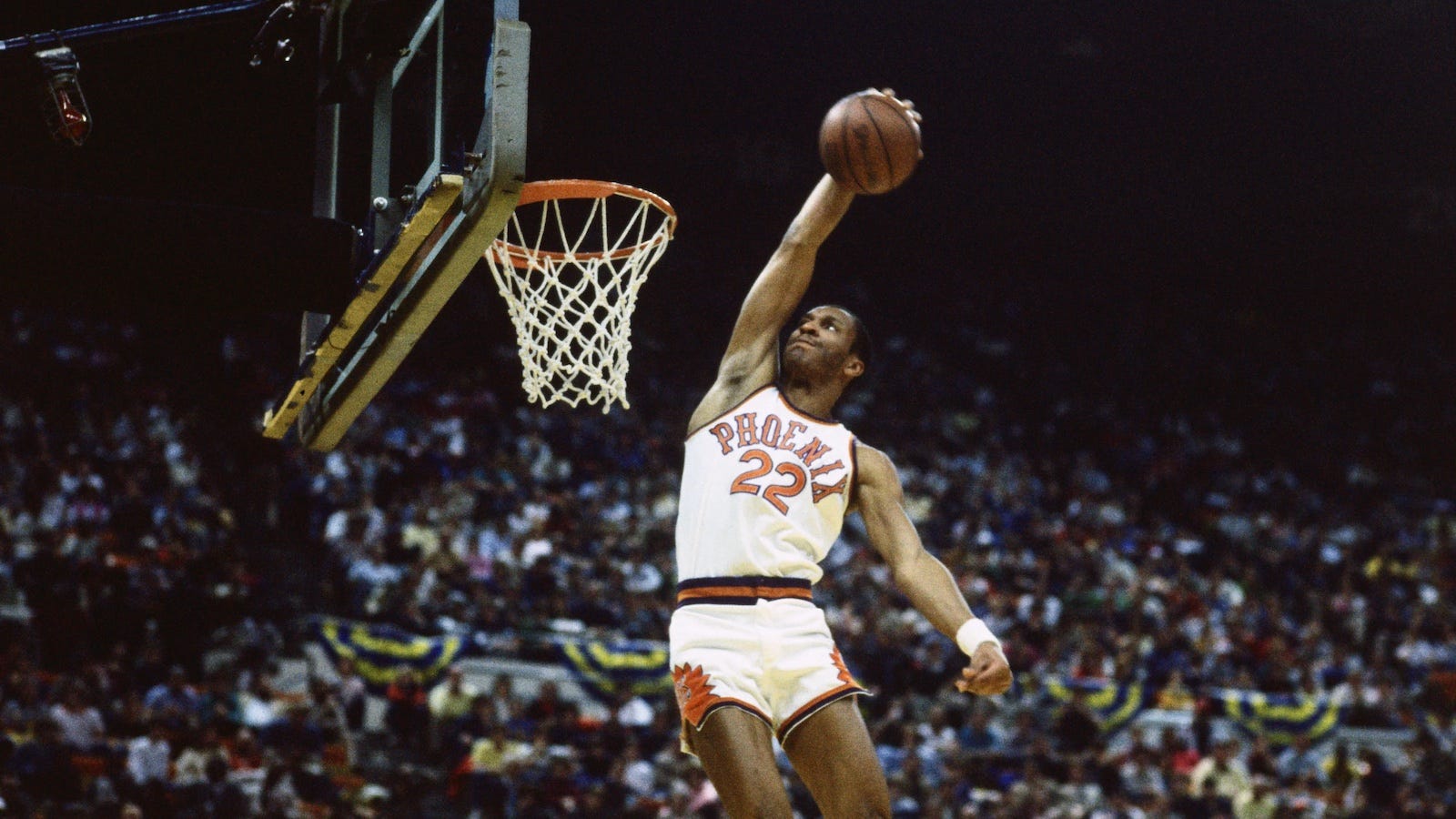
Nance was the winner of the NBA’s first Slam Dunk Contest in 1984, but other than that there is nothing especially noteworthy.
The Verdict
As noted earlier, Nance’s career statistical value places him in a muddled group in which he’s surrounded by Hall of Famers and non-Hall of Famers alike. A player who is “stuck” in the middle like that needs something extra — big seasons, postseason heroics, awards, etc. — to push him over the line.
Nance never earned All-NBA recognition, never won a major award, never played in the NBA Finals, and led the league in a major statistical category just once (games played, 1983-84). Nance was a very good player for a very long time, and that’s extremely valuable, but it’s not enough to make him a Hall of Famer in my book.
Good article. I n evaluating players, I personally stick to the stats (including advanced stats) and ignore accolades and all that. I also believe that cumulative achievement above average (aka, "quality longevity") is important. Finally, I believe that players should be compared primarily to others at the same position.
Some keys for an evaluation of Nance are: 1) How good do you think his defense was? 2) How much do you value defense in overall evaluation? 3) How much do you value offensive efficiency (ORtg), especially shooting efficiency and low turnovers. My answers: Nance was a very good defender according to DBPM & DWS and on film and by reputation; defense should be weighted heavily; and efficiency & ORtg should be weighted heavily (Nance was very efficient). All pluses for Nance.
Based on all that, a quick glance shows me that Nance's best comps are probably McHale, Webber, and going farther back, Bailey Howell. All played PF and are similar in MP (longevity), BPM/VORP, WS & WS/48, and PER, plus the traditional stats. (Webber is lower in WS & WS/48 because of poor shooting efficiency and high turnovers.) All 3 of those players are in the HOF, which doesn't mean Nance should be. But it does help Nance's case.