


I thought it might be fun to pick what I think is the best NBA season at each age* for players ranging from 19 to 40 years old. Although I gave a lot weight to the statistical evidence, this was definitely part art and part science, meaning I didn’t rely on a single statistic or formula to produce an answer.
* Player age is calculated on Feb. 1 of the given campaign, which is roughly the halfway point of the regular season.
This is the second part of a two-part series (here’s a link to part one, where I covered players 19 to 29 years old). Today, I’ll cover players in the age range from 30 to 40 years.
Age 30: Wilt Chamberlain, 1966-67
Chamberlain made a concerted effort to involve his teammates more in 1966-67, and it paid off in a big way. On a per-game basis, he ranked fifth in the NBA in scoring (24.1 PPG), first in rebounding (24.2 RPG), and third in assists (7.8 APG) while appearing in all 81 games. Chamberlain also set a then-NBA-record by converting 68.3% of his shots from the field. His Philadelphia 76ers set a league record with 68 wins (since broken), then defeated the San Francisco Warriors 4-2 in the Finals to give Chamberlain his first NBA title.
Honorable Mention (in chronological order): Bill Russell, 1964-65; Larry Bird, 1986-87; Magic Johnson, 1989-90; David Robinson, 1995-96.
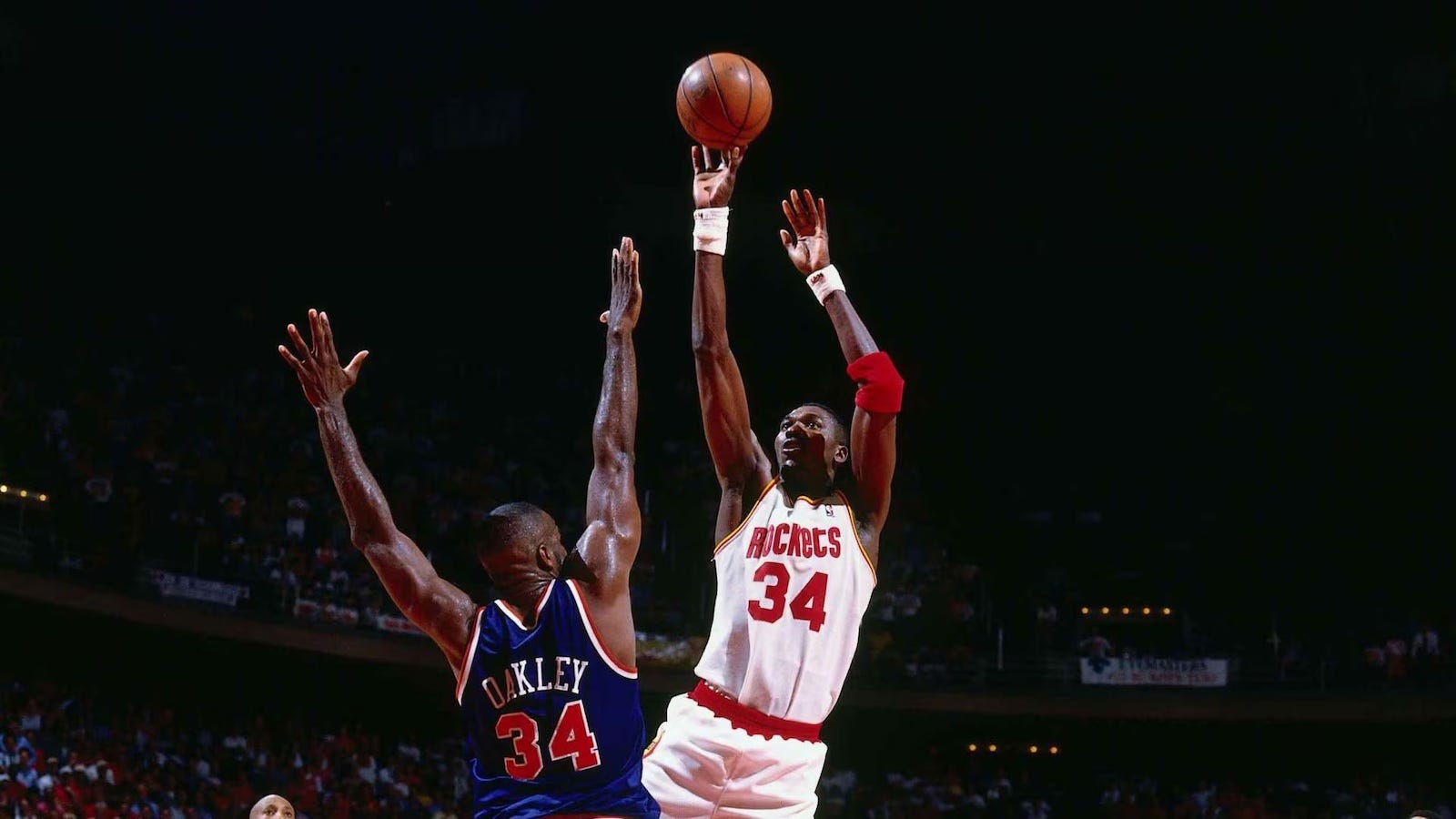
Age 31: Hakeem Olajuwon, 1993-94
A “Dream” season for Olajuwon in which he won the MVP, Defensive Player of the Year, and Finals MVP Awards (he’s still the only player to pull off that trifecta). In 80 games played, Olajuwon averaged 27.3 PPG (third in the league), 11.9 RPG (fourth), and 3.7 BPG (second) while shooting 52.8% from the field (10th) for a Houston Rockets team that finished second in the NBA with 58 wins. The Rockets were even better in the playoffs, winning the franchises’s first title as Olajuwon averaged 28.9 PPG, 11.0 RPG, and 4.0 BPG in 23 games.
Honorable Mention: Wilt Chamberlain, 1967-68; Larry Bird, 1987-88; Magic Johnson, 1990-91; LeBron James, 2015-16.
Age 32: Michael Jordan, 1995-96
Playing his first full campaign after an abrupt retirement following the 1992-93 season, Jordan and the Chicago Bulls ran roughshod over the NBA. Jordan won his fourth MVP Award, averaging 30.4 PPG (first in the NBA), 6.6 RPG, 4.3 APG, and 2.2 SPG (third) while playing all 82 games. He was efficient, as usual, recording 49.5/42.7/83.4 shooting splits. The Bulls became the first team in NBA history to win 70 games, posting a 72-10 record in the regular season. In the postseason, Chicago picked up its fourth championship in six seasons, as Jordan took home Finals MVP honors for the fourth time.
Honorable Mention: Kareem Abdul-Jabbar, 1979-80; Karl Malone, 1995-96; David Robinson, 1997-98; LeBron James, 2016-17.
Age 33: Michael Jordan, 1996-97
This was the season in which Jordan, peeved because he narrowly lost the MVP voting race to Karl Malone, exacted his revenge in the NBA Finals. Their regular seasons were very similar (in terms of overall production), and I can see voting for Malone for MVP, but Jordan emerges as a clear choice when the postseason is considered. Appearing in all 82 regular season games, he scored 29.6 PPG (first in the league) on 48.6/37.4/83.3 shooting splits, also averaging 5.9 RPG, 4.3 APG, and 1.7 SPG. Jordan upped his production to 31.1 PPG, 7.9 RPG, and 4.8 APG in the playoffs as the Chicago Bulls went 15-4 to claim their fifth NBA title in seven seasons, with Jordan winning the Finals MVP Award for the fifth time in five tries.
Honorable Mention: Jerry West, 1971-72; Kareem Abdul-Jabbar, 1980-81; Karl Malone, 1996-97; LeBron James, 2017-18.
Age 34: Michael Jordan, 1997-98
Yep, it’s a three-peat for Jordan in what would turn out to be his last great season as a pro. He won his NBA-record 10th and final scoring title, averaging 28.7 PPG to go with 5.8 RPG, 3.5 APG, and 1.7 SPG in 82 games. Jordan was named MVP for the fifth time and Finals MVP for the sixth time, the fourth season in which he received both honors (two more than any other player). He averaged 32.4 PPG in 21 playoff games to lead the Chicago Bulls to their sixth ring in eight seasons.
Honorable Mention: Wilt Chamberlain, 1970-71; John Stockton, 1996-97; Karl Malone, 1997-98; Kobe Bryant, 2012-13.
Age 35: Wilt Chamberlain, 1971-72
Although he averaged less than 20 PPG for the first time in his career, Chamberlain was the defensive anchor for a Los Angeles Lakers team that went 69-13 (a league record, at the time) and won its first NBA title since moving to Los Angeles. He averaged 14.8 PPG, 19.2 RPG (first in the league), and 4.0 APG in 82 games, shooting 64.9% from the field (first). Chamberlain was named All-NBA Second Team and All-Defensive First Team. He also won the Finals MVP Award, averaging 19.4 PPG and 23.2 RPG in a 4-1 series win over the New York Knicks.
Honorable Mention: Kareem Abdul-Jabbar, 1982-83; Karl Malone, 1998-99; David Robinson, 2000-01; LeBron James, 2019-20.
Age 36: Wilt Chamberlain, 1972-73
Chamberlain ended his NBA career with another stellar season, averaging 13.2 PPG, a league-leading 18.6 RPG, and 4.5 APG while appearing in all 82 games. He broke his own record for highest field goal percentage in a season, shooting 72.7% from the floor (a mark that would stand for 47 years). Chamberlain was named All-Defensive First Team and placed fourth in the MVP Award voting. His Los Angeles Lakers won 60 games during the regular season and advanced to the NBA Finals, where they fell to the New York Knicks.
Honorable Mention: Karl Malone, 1999-00; David Robinson, 2001-02; Tim Duncan, 2012-13; Chris Paul, 2021-22.
Age 37: Kareem Abdul-Jabbar, 1984-85
Abdul-Jabbar had a solid if unspectacular regular season, averaging 22.0 PPG, 7.9 RPG, and 2.1 BPG in 79 games while shooting 59.9% from the field (fourth in the NBA). He was named All-NBA Second Team and finished fourth in the MVP balloting. Abdul-Jabbar’s Los Angles Lakers went 62-20 in the regular season, then posted a 15-4 record in the postseason to claim their third title in six seasons. He became the oldest player to win Finals MVP (a record which still stands), averaging 25.7 PPG, 9.0 RPG, and 5.2 APG as the Lakers defeated the Boston Celtics in six games.
Honorable Mention: Robert Parish, 1990-91; John Stockton, 1999-00; Karl Malone, 2000-01; Tim Duncan 2013-14.
Age 38: Kareem Abdul-Jabbar, 1985-86
In his 17th season, Abdul-Jabbar earned his 10th and final All-NBA First Team nod. He averaged 23.4 PPG, 6.1 RPG, and 1.6 BPG in 79 games, shooting 56.4% from the field (seventh in the NBA) and 76.5% from the free throw line. Abdul-Jabbar also finished fifth in the MVP Award voting, his 17th consecutive season placing in the top 10. Abdul-Jabbar’s Los Angeles Lakers won 62 games in the regular season (11 more than any other Western Conference team), but were upset by the Houston Rockets in the conference finals.
Honorable Mention: John Stockton, 2000-01; Karl Malone, 2001-02; Tim Duncan, 2014-15; LeBron James, 2022-23.
Age 39: LeBron James, 2023-24
James averaged 25.7 PPG, 7.3 RPG, and 8.3 APG (fifth in the NBA) in 71 games for the Los Angeles Lakers, the first time he appeared in more than 67 games since the 2017-18 season. He shot 54.0% from the field and a career-high 41.0% from 3-point range. James was named All-NBA Third Team, the 20th consecutive season in which he earned All-NBA honors. The Lakers (47-35) had to qualify for the playoffs via the Play-In Tournament, but their stay was short-lived as the Denver Nuggets eliminated them in five games in the first round.
Honorable Mention: Kareem Abdul-Jabbar, 1986-87; Robert Parish, 1992-93; John Stockton, 2001-02; Karl Malone, 2002-03.
Age 40: LeBron James, 2024-25
James continued to defy Father Time, posting figures of 24.4 PPG, 7.8 RPG, and 8.2 APG (sixth in the NBA) in 70 games. He connected on 51.3% of his attempts from the field and shot a career-best 78.2% from the free throw line. James earned All-NBA honors for the 21st time (Second Team), six more such selections than any other player. His Los Angeles Lakers went 50-32 and earned the third seed in the Western Conference playoffs, but were once again eliminated in the first round of the playoffs in five games, this time by the Minnesota Timberwolves.
Honorable Mention: Kareem Abdul-Jabbar, 1987-88; Robert Parish, 1993-94; John Stockton, 2002-03; Karl Malone, 2003-04.