


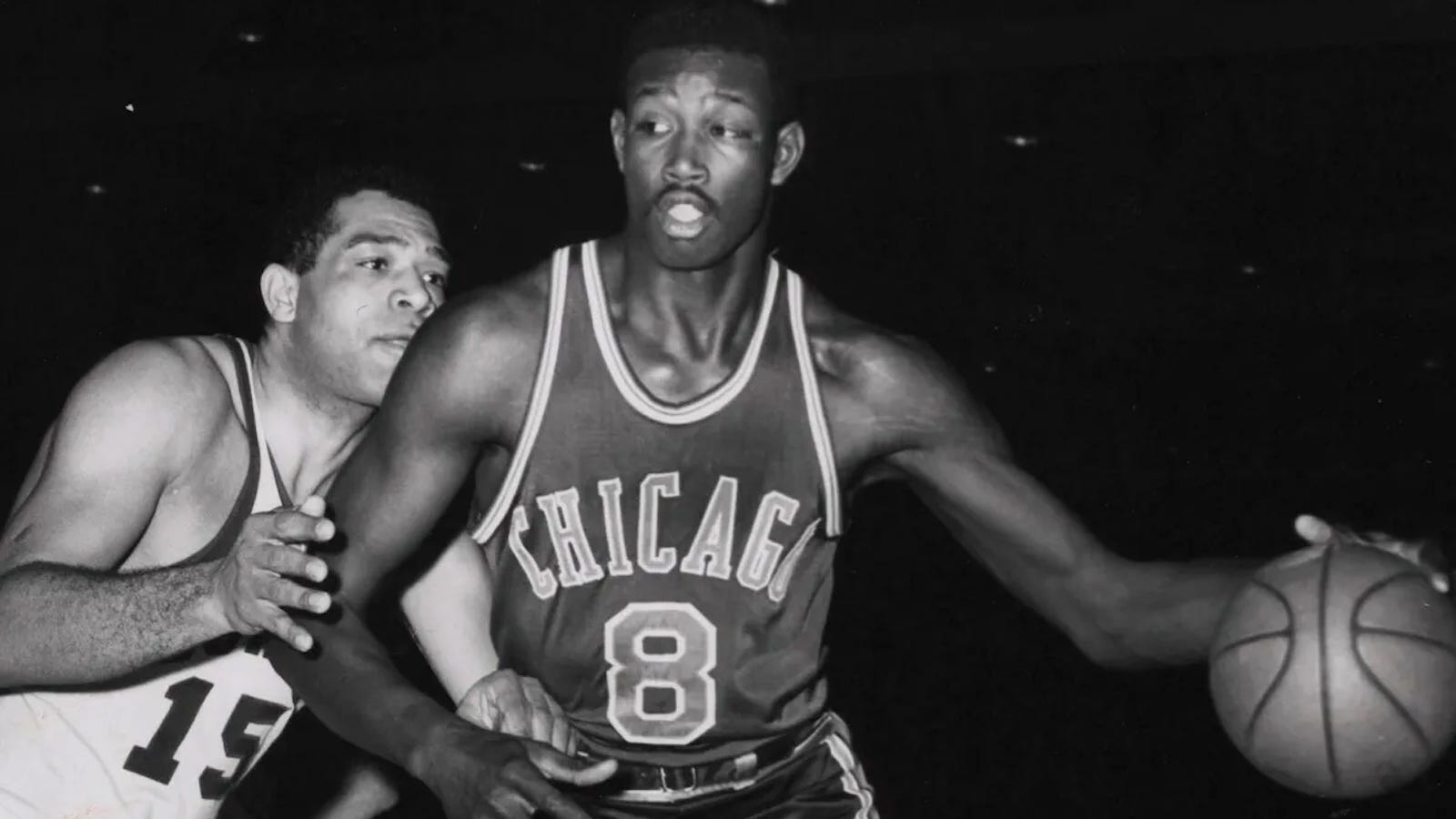
The other day I was doing some research on the greatest rookie seasons of all time and ended up getting sidetracked by Walt Bellamy. Walt Bellamy? Yes, Walt Bellamy. You see, Bellamy had his finest season in the NBA as a rookie, a feat that I thought had to be highly unusual given the Hall of Famer’s 14-season, 1043-game career. And just like that, I had an idea for my next piece: How many players with careers of significant length had their peak season as a rookie?
Before I could go about answering this question, I had two define two terms:
What is a career of significant length? Lots of players who played just a handful of seasons peaked as rookies, so I decided to restrict my attention to players who debuted in the 1951-52 season or later (when minutes were first recorded) and played in at least 820 games. This gave me a pool of 397 players. I then decided to remove the six players who played in the ABA (Julius Erving, Artis Gilmore, Caldwell Jones, Maurice Lucas, Moses Malone, and Mark Olberding), reducing the sample to 391 players.
How do you determine a player’s peak season? There’s no one right answer, of course, but I decided a player’s peak season should take into account both his efficiency and overall production. I settled on a simple formula: Player Efficiency Rating (PER), divided by 15 (the league average), multiplied by minutes. Note that the score of an average player using this method will be equal to his minutes.
Now that I had a player pool and a definition for seasonal value, I could move on to the good stuff. First, here’s a summary of the number of players who achieved their peak score in a particular season:
1st — 8 (2.0%)
2nd — 23 (5.9%)
3rd — 48 (12.3%)
4th — 45 (11.5%)
5th — 54 (13.8%)
6th — 61 (15.6%)
7th — 48 (12.3%)
8th — 39 (10.0%)
9th — 33 (8.4%)
10th — 20 (5.1%)
11th — 5 (1.3%)
12th — 4 (1.0%)
13th — 3 (0.8%)
A few observations:
Only eight of these players achieved their peak score in their rookie season (more on them below).
More players achieved their peak score in their sixth season than any other season.
A majority of these players (61.1%) had achieved their peak score by the end of their sixth season.
The three players who achieved their peak score in their 13th season are Robert Parish (1988-89), Lou Williams (2017-18), and DeMar DeRozan (2021-22).
Now, let’s take a close look at the players who peaked in their rookie season, going in chronological order:
Walt Bellamy (1961-62)
Rookie Score: 5,925
Second-Best Score: 5,496 (2nd season)
The 1961-62 Rookie of the Year Award winner, Bellamy produced what was probably one of the five greatest rookie seasons in NBA history playing for the Chicago Packers (now Washington Wizards). Bellamy finished second in the league in scoring (31.6 PPG) and third in rebounding (19.0 RPG); both of those figures ended up being his career highs. Bellamy also shot a league-best 51.9% from the field.
Although he played 14 seasons in the NBA, Bellamy’s first four campaigns were easily his best. In fact, only three players — Wilt Chamberlain, Kareem Abdul-Jabbar, and Oscar Robertson — had a higher score through the first four seasons of their career. Not coincidentally, those were the only seasons Bellamy was selected to play in the NBA All-Star Game.
Bellamy’s 14,241 career rebounds ranks 12th on the NBA’s all-time list. He’s one of only nine players in NBA history to average at least 20 PPG and 10 RPG in 1,000 or more games played.
Earl Monroe (1967-68)
Rookie Score: 3,879
Second-Best Score: 3,768 (2nd season)
A flashy, high-scoring guard drafted second overall by the Baltimore Bullets out of Winston-Salem State, Monroe started his career off with a bang, winning the Rookie of the Year Award while averaging 24.3 PPG, 5.7 RPG, and 4.3 APG in 82 games.
Monroe’s second season was nearly as good, with averages of 25.8 PPG, 3.5 RPG, and 4.9 APG in 80 games for a team that finished with the best record in the NBA. He earned All-NBA honors (First Team) for the first and only time in his career that season.
Although Monroe never again reached the statistical heights he did in his first two seasons, he was a solid, sometimes spectacular, player for most of his NBA career. Monroe was elected to the Hall of Fame in 1990 and was named to the NBA’s 75th Anniversary Team in 2021.
Alvan Adams (1975-76)
Rookie Score: 3,849
Second-Best Score: 3,221 (4th season)
Adams had a dream rookie season, averaging 19.0 PPG, 9.1 RPG, 5.6 APG, 1.5 SPG, and 1.5 BPG in 80 games. He earned the only All-Star selection of his career, won the Rookie of the Year Award, and led the Phoenix Suns to their first NBA Finals appearance. Adams maintained his high level of play in the postseason, averaging 17.9 PPG, 10.1 RPG, and 5.2 APG in 19 games. In fact, Adams and Magic Johnson are the only rookies in NBA history to average at least 15 PPG, 10 RPG, and 5 APG in the playoffs.
While Adams was a reliable and effective player for the remainder of his career — he’s still the Suns’ all-time leader in games played, minutes, offensive rebounds, total rebounds, and steals — he never again reached the statistical heights attained in his debut season.
Walter Davis (1977-78)
Rookie Score: 3,822
Second-Best Score: 3,745 (2nd season)
Davis — who, like Adams, played for the Suns — had an outstanding rookie season, averaging a career-high 24.2 PPG while shooting 52.6% from the field and 83.0% from the free throw line. Davis won the Rookie of the Year Award and was named All-NBA Second Team.
Davis’ first two seasons were the best of his career, and although he would go on to earn four more All-Star selections after that he was never again the same player. Part of that is due to the back problems that plagued him later his career, but drug problems (which came to light in 1985) no doubt played a big role in his decline.
Trivia: Davis is one of only three qualified* players in NBA history to shoot at least 50% from the field and 85% from the free throw line for his career. The others to achieve the feat are Chris Mullin and Kiki VanDeWeghe.
* Minimum 2,000 field goals made and 1,200 free throws made.
Bill Cartwright (1979-80)
Rookie Score: 3,767
Second-Best Score: 3,595 (2nd season)
The third overall pick by the New York Knicks out of San Francisco, Cartwright averaged a career-high 21.7 PPG while playing all 82 games as a rookie. Cartwright also averaged a career-best 8.9 RPG and ranked ninth in the NBA in field goal percentage (54.7%), earning the only All-Star selection of his career. In most seasons Cartwright would have been named Rookie of the Year, but he had to settle for All-Rookie First Team honors since Larry Bird (the winner) and Magic Johnson also made their debuts that season.
Cartwright sat out the entire 1984-85 season and all but two games of the 1985-86 season due to chronic foot problems. In 1988 Cartwright was traded to the Chicago Bulls for Charles Oakley, where he was the starting center for three title-winning teams (1991, 1992, and 1993).
Larry Smith (1980-81)
Rookie Score: 2,548
Second-Best Score: 2,515 (5th season)
Smith was a bruising power forward with a singular talent: rebounding, especially on the offensive boards. As a rookie, Smith averaged 12.1 RPG, leading the NBA in both offensive rebound percentage and total rebound percentage. Smith was named All-Rookie First Team and finished third in the Rookie of the Year voting (one spot ahead of future Hall of Famer Kevin McHale).
Over the course of his career, Smith finished in the top 10 in offensive rebounds eight times; only seven players have more top-10 appearances since the NBA began tracking the statistic in 1973-74. Smith’s career offensive rebound percentage of 15.8% ranks fourth on the all-time list, trailing only Dennis Rodman, Moses Malone, and Andre Drummond.
Chuck Person (1986-87)
Rookie Score: 3,071
Second-Best Score: 3,051 (3rd season)
The 1986-87 Rookie of the Year, Person averaged 18.8 PPG and 8.3 RPG while appearing in all 82 games for the Indiana Pacers, who improved from 26-56 the previous season to 41-41.
Person had several other seasons similar to his debut, but never surpassed that statistical high. Person averaged double figures in scoring in each of his first 10 seasons, finishing with a career average of 14.7 PPG. He became something of a 3-point specialist in the middle-to-late stage of his career, making at least 100 long-range shots in five consecutive seasons.
Shane Battier (2001-02)
Rookie Score: 2,876
Second-Best Score: 2,783 (5th season)
Battier averaged 14.4 PPG, 5.4 RPG, 2.8 APG, and 1.6 SPG — all career-high figures — in his rookie season with the Memphis Grizzlies. Battier’s 1,125 points scored as a rookie are by far his career high, easily surpassing the 829 points he scored in 2006-07 with the Houston Rockets. Battier was named All-Rookie First Team, an honor also achieved by teammate Pau Gasol (who was named Rookie of the Year).
Battier became a defensive specialist, being named All-Defensive Second Team in 2007-08 and 2008-09 with the Rockets. Late in his career, Battier won back-to-back NBA titles playing for the Miami Heat (2012 and 2013).
I always think it's strange that the 1970s-80s Suns stars played so few minutes. Adams averaged only 27.5 MP/G for his career with a high of 33.2 his rookie year. Adams never averaged 20 P/G or 10 R/G. But averaged over 20 P/36 five times and 10 R/36 four times. Davis only averaged 27.9 MP/G for his career, with a high of 33.5. His high P/G was 24.2 as a rookie, but he averaged over 24.2 P/36 *eight* times! Westphal averaged only 25.5 MP/G, 30.6 with Suns. Westphal's 29.2 P/ 36 in 1978 (same as Davis' big rookie year) was one of the highest ever at the time.
Obviously, the answer is the Suns' coach, John MacLeod. But that still doesn't explain why MacLeod, unlike every other coach in the NBA, had such low MP for his stars
7/8 happened before 1986-7. Did players start entering the league younger and in need of more development after that point, leading to fewer dominant rookie seasons? Or is it just a fluke that 7 of the 8 are within a 24 year time span with only 1 happening in the 36 years since?