


Many people are touting the 2026 NBA Draft as one of the deepest and most talented ever, but it will take many years to sort out its place in history. Below is an update to a piece I wrote in June 2024 on the greatest draft classes of all time. It’s unlocked for all readers, but if you’re a free subscriber, please give some thought to upgrading to a paid subscription, or you could simply buy me a coffee. Thank you for your support.
There have been many articles written about the best draft classes in NBA history (almost all of which come to the same conclusion), but most of them have been qualitative in nature. There’s absolutely nothing wrong with that, but I wanted to approach this from a quantitative angle to see how things would shake out. My basic framework was:
Find a career value for each player from a given draft class.
Combine these career values to get a score for the entire draft.
Before I could compute a player’s career value, I needed a way to measure a player’s approximate value in a given season. I decided to use individualized wins, a replacement for another statistic I created, win shares*. I wanted to factor in the playoffs, so for a given season a player’s approximate value is defined to be the sum of his regular season and postseason individualized wins.
* Win shares, in my opinion, overrates low-usage/high-efficiency players and underrates high-usage/low-efficiency players.
In order to obtain a player’s career value, I used a weighting scheme similar to what Doug Drinen, creator of Pro-Football-Reference.com, uses for his Approximate Value metric (or AV, for short). Here’s Drinen’s description of the method:
My opinion is that most people mentally rank players by counting all the player’s seasons, but weighting their best seasons more. In order to mimic that, I’ve defined each player’s career “value” to be:
100% of his best season, plus 95% of his 2nd-best season, plus 90% of his 3rd-best season, …
So, for two players with the same career AV, the one with the higher peak will be rated a little higher. And junk seasons at the end of a player’s career count for almost nothing.
I computed the career value for every drafted player in NBA history. To turn this into a draft score, I used weights of 1.0 for the player with the highest career value in a given draft class, 0.95 for the player with the second-highest career value, 0.90 for the player with the third-highest career value, etc., and found the sum of these weighted values. My thinking was this would reward drafts with both high-end talent as well as depth.
Without further ado, here are the top five draft classes in NBA history using this method, with the score for each draft listed in parentheses.
Statitudes is a reader-supported publication. To receive new posts and support my work, consider becoming a free or paid subscriber.
#5: 1987 NBA Draft (788)
The top five players by career value:
David Robinson (168)
Reggie Miller (130)
Scottie Pippen (118)
Kevin Johnson (93)
Horace Grant (91)
Robinson, the top overall pick, had to delay his NBA career for two years in order to fulfill his commitment to the U.S. Navy. In his rookie season, the San Antonio Spurs saw a 35-win improvement (from 21-61 to 56-26), with Robinson winning the Rookie of the Year Award by unanimous vote.
This draft featured five players with a career value of at least 90, one more than any other class in history. The 1984, 1996, and 2003 draft classes had four such players apiece.
#4: 2003 NBA Draft (830)
The top five players by career value:
LeBron James (247)
Dwyane Wade (140)
Carmelo Anthony (103)
Chris Bosh (95)
David West (78)
James (first overall pick), Wade (fifth), Anthony (third), and Bosh (fourth) were all selected in the top five, while West was picked 18th overall. The second overall selection in this draft was Darko Milicic, one of the biggest busts in NBA history.
The player’s in this draft class accounted for 62 NBA All-Star Game selections, the second-highest such total in history. You’ll see which class was first by this measure in a bit.
#3: 1985 NBA Draft (851)
The top five players by career value:
Karl Malone (200)
Patrick Ewing (126)
Terry Porter (91)
Detlef Schrempf (85)
Chris Mullin (81)
Ewing was the first overall pick in this draft, but the others listed above were selected seventh (Mullin), eighth (Schrempf), 13th (Malone), and 24th (Porter). Porter attended the University of Wisconsin–Stevens Point, at the time an NAIA school. In my opinion, both he and Schrempf have good Hall of Fame cases.
This draft produced six players with a career value of at least 75, one more than any other class. That group is made up of the five players above, plus Joe Dumars (77).
#2: 1996 NBA Draft (863)
The top five players by career value:
Kobe Bryant (181)
Ray Allen (118)
Steve Nash (115)
Allen Iverson (114)
Stephon Marbury (75)
Allen (fifth overall pick), Iverson (first), and Marbury (fourth) were all taken in the top five picks, but Bryant and Nash were the 13th and 15th overall selections, respectively. Bryant, Nash, and Iverson each won at least one MVP Award, tied for the most such winners in a single draft class (more on this below).
No draft class in NBA history has produced more All-Star Game selections (64). Ten different players accounted for these selections, including six of the top seven picks. The lone non-All-Star in the top seven was second overall pick Marcus Camby, who won the Defensive Player of the Year Award in 2006-07 and was a four-time All-Defensive selection.
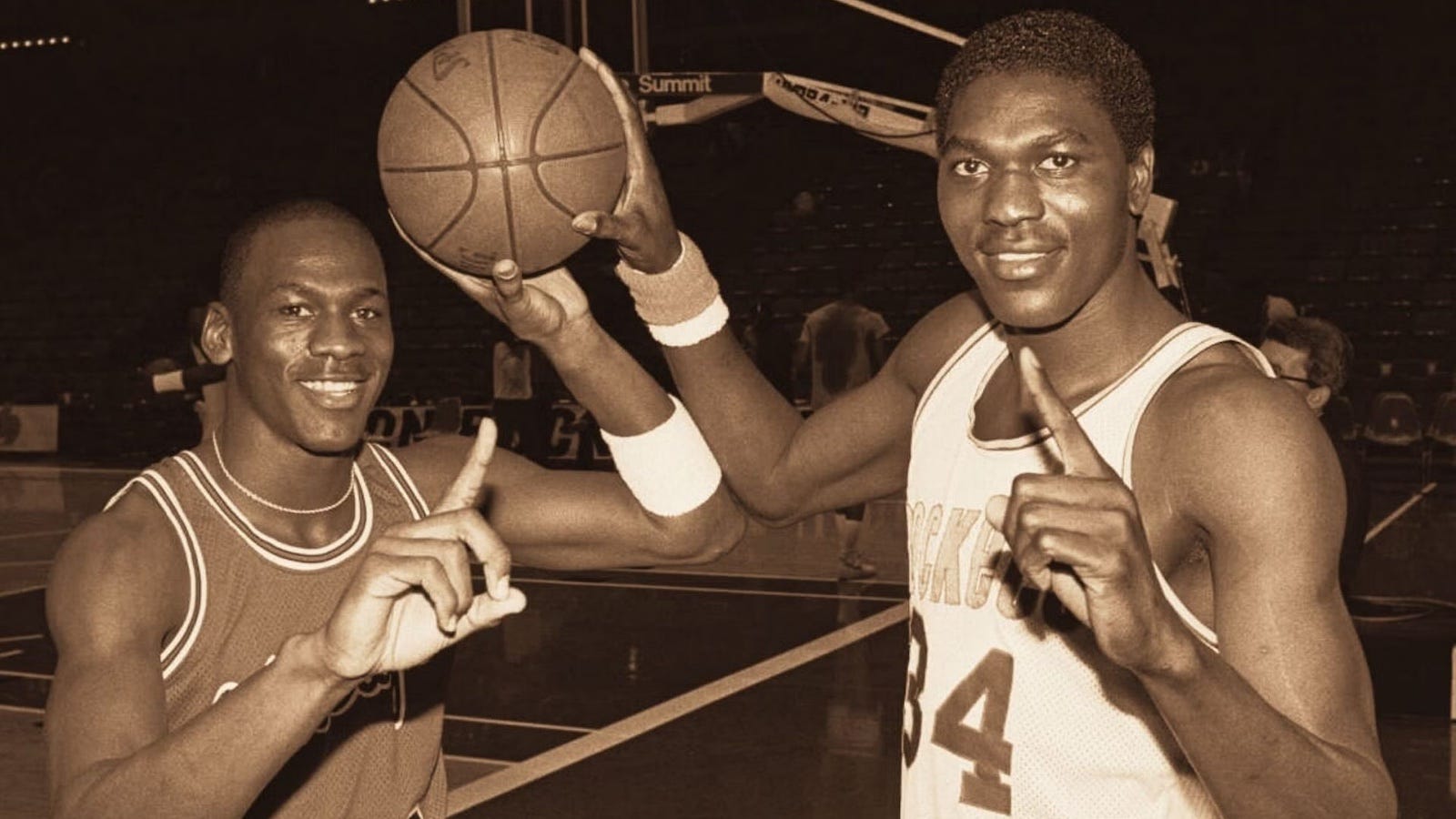
#1: 1984 NBA Draft (977)
The top five players by career value:
Michael Jordan (231)
Charles Barkley (162)
Hakeem Olajuwon (156)
John Stockton (155)
Otis Thorpe (79)
This result shouldn’t come as a shock to anyone who knows a little bit about NBA history. This group — which has been the subject of a documentary by NBA TV and a book by Filip Bondy — stands head and shoulders above the rest.
There have been deeper drafts, but none come close to matching the quality at the top of this group. Four of these players have a career value of at least 150. The only other draft class to produce even two such players is 2009 (Stephen Curry and James Harden).
Jordan, Barkley, and Olajuwon each won at least one MVP Award, tied with 1996 for the most such winners in a single draft class. They accounted for seven total MVP Awards (five for Jordan, one apiece for Olajuwon and Barkley), the most ever in one draft class.
This draft class also accounted for 47 All-NBA nods, a whopping 10 more than any other group. Olajuwon leads the way with 12 such selections, followed by Barkley, Jordan, and Stockton with 11 apiece. Alvin Robertson and Kevin Willis were also named to one All-NBA team each.
Thorpe earned just one All-Star selection in his 17-season career, but he was a very good player for a very long time. He’s one of 28 players in NBA history to reach career totals of 15,000 points and 10,000 rebounds, and his career field goal percentage of 54.6% ranks fifth in that group.