


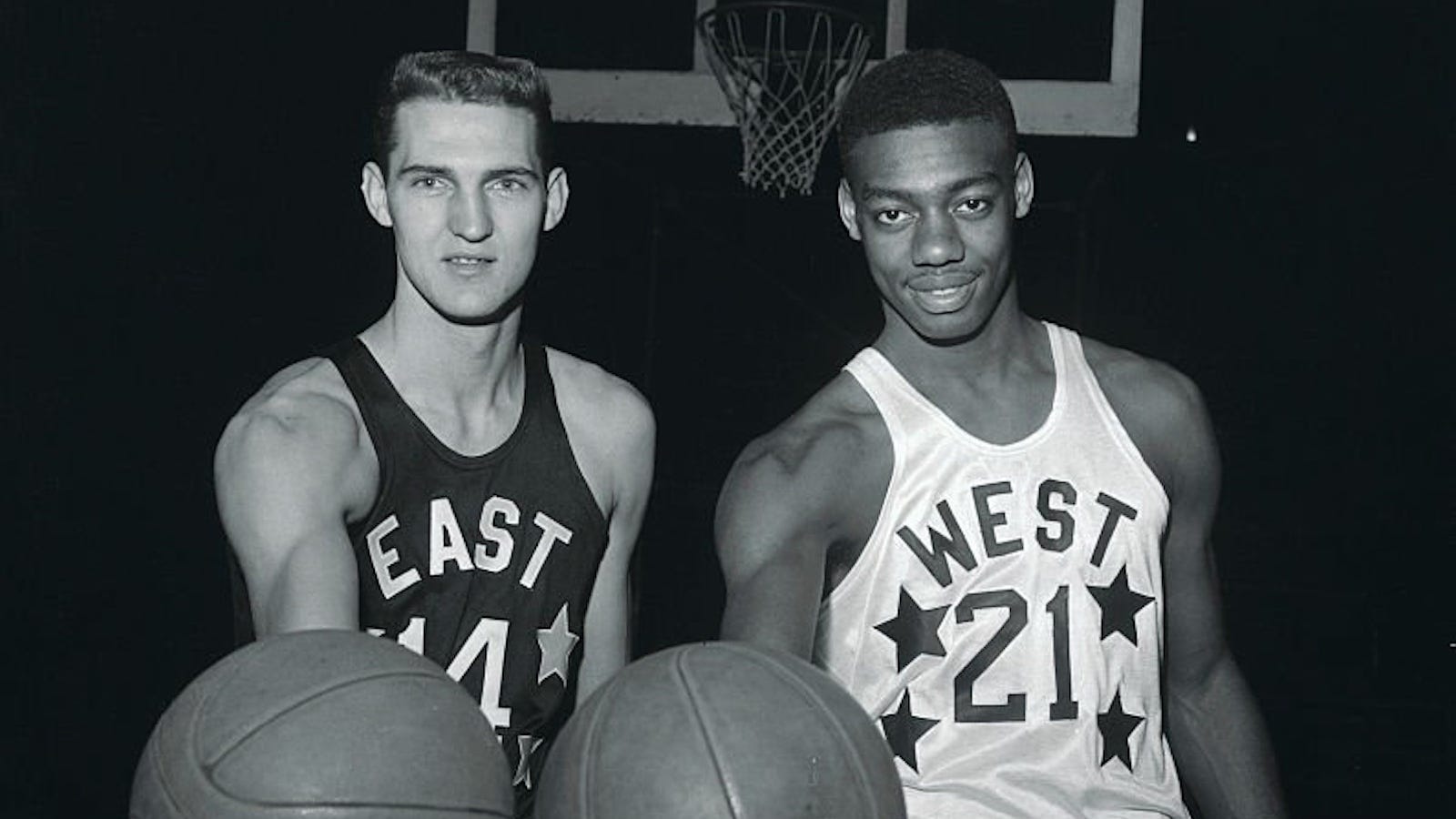
The FIBA Basketball World Cup has me thinking about past international competitions, and about how much things have changed since the 1992 Sumer Olympics, the first to feature NBA players.
Next year marks the 60th anniversary of the 1964 U.S. Men’s Olympic Basketball team. Led by Jerry Shipp and Bill Bradley, the U.S. went undefeated (9-0) and won the gold medal, beating its opponents by an average of 30 points per game.
But what if professional basketball players had been allowed to play in the 1964 Summer Olympics? What might the U.S. roster have looked like? I’m going to go back in time and select a 1964 “Dream Team” using two rules:
The roster will consist of 12 players and one head coach. I’ll name five starters and seven reserves.
I will only consider each player’s accomplishments through the 1962-63 season, as it would have been necessary to have the roster in place before the end of the 1963-64 season.
With those simple rules in place, let’s begin with the starting five.
Starters
Point Guard
I suppose there may have been some sentiment for Bob Cousy at the time, but I think the obvious choice here is Oscar Robertson.
As a collegian at the University of Cincinnati, Robertson was a three-time All-America selection and led the Bearcats to consecutive Final Four appearances in 1959 and 1960. He was also co-captain (with Jerry West) of the gold-medal-winning 1960 U.S. Olympic team.
After being selected by the Cincinnati Royals as a territorial pick in the 1960 NBA Draft, Robertson proceeded to average a triple-double (29.8 PPG, 11.0 RPG, and 10.2 APG) through his first three seasons in the league. Robertson also won the 1960-61 NBA Rookie of the Year Award, was named MVP of the 1961 NBA All-Star Game, and was a three-time All-NBA First Team selection.
Shooting Guard
Like Robertson, Jerry West was a three-time All-America selection and co-captain of the 1960 U.S. Olympic team. West was also named the Final Four’s Most Outstanding Player in 1959, when he led West Virginia to its first — and thus far only — appearance in the national championship game.
West struggled a bit as a rookie in 1960-61, averaging 17.6 PPG while shooting 41.9% from the field and 66.6% from the free throw line. But West found his groove in his second season, recording averages of 30.8 PPG, 7.9 RPG, and 5.4 APG, which earned him the first of what would be six consecutive All-NBA First Team selections.
West was a combo guard — he could seamlessly switch between point guard and shooting guard — so his selection will also allow for some more flexibility when it comes time to select the reserves.
Small Forward
Elgin Baylor is an easy choice at small forward. Through his first five seasons in the NBA, Baylor averaged 32.0 PPG and 16.7 RPG and was a five-time All-NBA First Team selection.
Unfortunately, Baylor’s production noticeably slipped after that, as knee injuries and age started to take their toll. But that doesn’t matter for our purposes, as at the time the selections would have been made Baylor was easily one of the five best players in the NBA.
Power Forward
Another easy selection: Bob Pettit.
Following the 1962-63 season, Pettit was named All-NBA First Team for the ninth straight time, a streak that would reach 10 following the 1963-64 season. Pettit averaged at least 20 PPG and 10 RPG in each of those seasons.
Petit was named NBA MVP following the 1955-56 and 1958-59 seasons, and in 1957-58 he led the St. Louis Hawks to the only championship in franchise history. It should also be noted that Petit’s Hawks were the only squad to defeat one of Bill Russell’s teams in the NBA Finals.
Center
The eternal debate: Wilt Chamberlain or Bill Russell?
There are two indisputable facts:
Chamberlain had the stats.
Russell had the rings.
Through the 1962-63 season, Chamberlain had ridiculous numbers, with career averages of 42.9 PPG and 26.0 RPG. Chamberlain had also been named All-NBA First Team in three of his first four seasons, and he won the Rookie of the Year Award as well as the MVP Award following the 1965-60 season.
Russell arrived in the NBA in 1956-57, and in his first seven seasons he collected six of his 11 career titles. He had also won four MVP Awards, including three in a row from 1960-61 to 1962-63.
So you have a strange thing going on here: Chamberlain is posting video-game numbers and winning All-NBA First Team honors, while Russell is taking home MVP Awards and adding to his ring collection.
This is obviously a very tough choice. But since I’m trying to put together the best team possible, I’m inclined to go with perhaps the best team player in NBA history, and that would be Bill Russell.
Reserves
Guards
Although Bob Cousy retired following the 1962-63 season, I think he would have been chosen to play on this team. Cousy was named to one of the All-NBA teams every season from 1951-52 to 1962-63, the first 10 of those being First Team selections. During that stretch, Cousy led the NBA in both assists and assists per game for eight consecutive seasons (1952-53 to 1959-60).
Cousy’s major weakness as a player was his inefficient shooting from the floor. Among players with at least 2,000 field goals made, Cousy’s career field goal percentage of 37.5% is the 15th-lowest in NBA history.
Cousy was able to offset that to a degree with his free throw shooting, as he ranked in the top 10 in the NBA in free throw attempts six times and had a career free throw percentage of 80.3%.
Hal Greer made his NBA debut in 1957-58, and in 1961 earned the first of what would be 11 consecutive All-Star selections. Greer was also named All-NBA Second Team in 1962-63, starting a streak of seven consecutive All-NBA Second Team nods.
From 1960-61 to 1962-63, Greer led the NBA in games played twice and averaged 20.6 PPG, 6.2 RPG, and 3.9 APG. Thanks to shooting percentages of 45.4% from the field and 81.0% from the free throw line — very good marks for that time — Greer’s true shooting percentage over that three-season span was 50.8%, the 10th-highest in the NBA among players with at least 2,500 points.
By the way, choosing Greer over Sam Jones was the toughest selection I had to make. I just felt that Greer had the better resume at that time, as Jones had only been named to one All-Star team and had not yet earned an All-NBA selection.
Forwards
Jack Twyman was a 6-foot-6-inch small forward who could also play shooting guard, so he lends some versatility to the roster. After eight seasons in the league, Twyman had been named to six All-Star teams and had two All-NBA Second Team selections to his credit (1959-60 and 1961-62).
Twyman’s career averages at the time were 21.7 PPG and 7.5 RPG, with field goal and free throw percentages of 45.0% and 77.1%, respectively. And even though that field goal percentage may not be impressive today, at the time it was the eighth-highest in NBA history among players with at least 2,000 field goals made.
Bailey Howell was a two-time All-America selection at Mississippi State before joining the NBA in 1959-60 with the Detroit Pistons. Howell earned his first All-Star berth the next season, and by the end of the 1962-63 season he was a three-time All-Star selection and one-time All-NBA Second Team selection.
Howell was a double-double threat on a nightly basis — he averaged 21.0 PPG and 12.3 RPG through his first four seasons — and was an efficient scorer, having landed in the top 10 in field goal percentage, free throws made, and free throws attempted three times in that span.
Tom Heinsohn was named to the All-Star team and won the Rookie of the Year Award in 1956-57, but after that he didn’t receive any more major honors until the 1960-61 season.
From 1960-61 to 1962-63, though, Heinsohn made three consecutive All-Star teams and was named All-NBA Second Team three straight times (streaks which eventually reached five and four seasons, respectively). Heinsohn had also won six championships as a member of the Boston Celtics, and would be a member of two more title-winning teams in 1964 and 1965.
I guess I should comment on two omissions at forward. The first is Dolph Schayes, a 12-time All-NBA selection. Schayes was clearly nearing the end of his career at this point (he retired following the 1963-64 season), averaging then-career-lows of 9.5 PPG and 5.7 RPG in 1962-63.
The second is Jerry Lucas. Lucas, to this point, had not played a single minute in the NBA, opting to play for the Cleveland Pipers of the American Basketball League after leaving Ohio State. The upstart league folded in 1962, but Lucas had to sit out the entire 1962-63 NBA season due to his business dealings with George Steinbrenner and the ABL.
Centers
Wilt Chamberlain, of course.
Like Robertson and West, Walt Bellamy was a member of the 1960 U.S. Olympic team that won the gold medal in Rome. Bellamy was a beast his first two years in the NBA, averaging 29.7 PPG and 17.7 RPG while finishing first and then second in the league in field goal percentage.
Bellamy won the Rookie of the Year Award in 1961-62, and he would have been named to one of the All-NBA teams both seasons had it not been for two guys named Chamberlain and Russell.
I should also note that Bellamy had an unusual career in that his first four seasons were easily his best in the NBA. This is something I’ve written about in the past.
Head Coach
It has to be Red Auerbach — there’s really no room for debate. Auerbach’s Celtics had won six of the past seven championships, with the only miss coming in 1958 when Boston lost the NBA Finals in six games to the St. Louis Hawks.
The 1964 Dream Team
The table below provides a summary of my roster selections for the 1964 Dream Team. All statistics (PPG/RPG/APG) are through the 1962-63 NBA season:
Red Auerbach (Head Coach)
Elgin Baylor (32.0/16.7/4.4)
Walt Bellamy (29.7/17.7/2.8)
Wilt Chamberlain (42.9/26.0/2.5)
Bob Cousy (18.5/5.2/7.6)
Hal Greer (17.4/5.3/3.2)
Tom Heinsohn (19.6/9.6/1.9)
Bailey Howell (21.0/12.3/2.2)
Bob Pettit (26.5/16.6/3.0)
Oscar Robertson (29.8/11.0/10.2)
Bill Russell (17.1/23.1/3.5)
Jack Twyman (21.7/7.5/2.5)
Jerry West (24.8/7.6/5.0)
Another great article, Justin! Hard to argue with most of your picks.
That said, I'd have Sam Jones over Hal Greer.
Russell would be a great fit on an offense-heavy team. But Wilt *was* a "team player" when he had good teammates. He averaged 5.0 A/G in 1963-64, 6th in the NBA. And of course, he later was 3rd and 2nd in A/G in 1966-67 & 67-68.